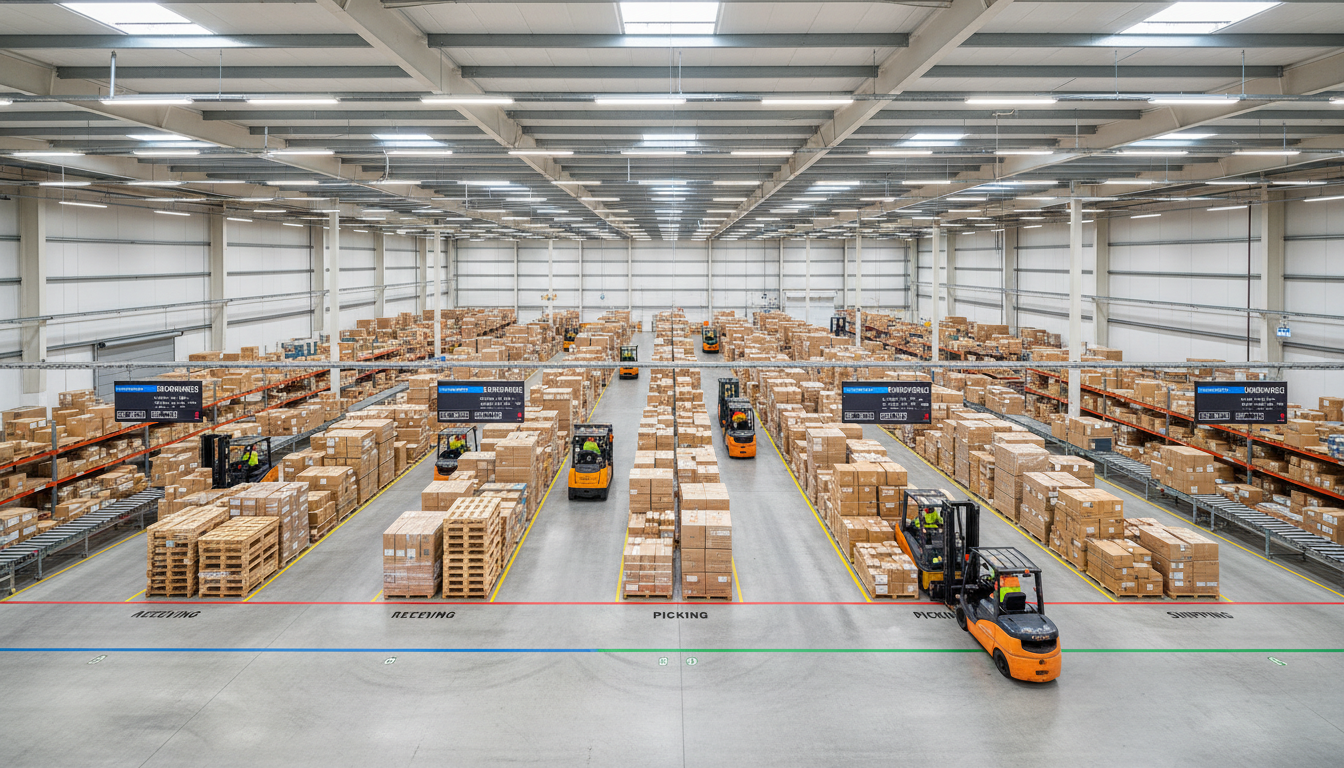
Maximizing warehouse efficiency for small distributors requires optimizing storage layouts, tracking key performance indicators, and implementing spreadsheet-based inventory monitoring. Prioritizing ABC analysis and reconfiguring aisles to minimize travel time ensures that operations remain productive without the need for immediate, expensive software investments.
Small distributors often find themselves trapped in a frustrating middle ground. Your order volume is high enough to cause operational friction; yet, your margins cannot yet justify the mid six figure investment of a sophisticated Warehouse Management System. You are likely losing time to inefficient travel paths and losing money to picking errors. This operational drag limits your capacity to scale. At JRG Consulting, we believe that efficiency is a matter of discipline and logic rather than expensive software alone. This article outlines a practical, spreadsheet first approach to reclaiming your floor space. You will learn how to conduct a ground level audit, optimize your layout without purchasing new equipment, and implement batching logic to accelerate fulfillment. We will also define the specific KPIs that signal when your operation is finally ready to transition from manual sheets to automated systems.
The Small Distributor Paradox: Why Big Software Often Fails Early Stage Operations
Small manufacturers and distributors across Utah often fall into a trap where they believe a high-priced Warehouse Management System (WMS) will solve fundamental operational bottlenecks. In reality, purchasing enterprise software before establishing rigorous workflows is a costly mistake that often leads to digitized chaos. For a Millard County agricultural supplier or a specialized niche distributor, the logic of the floor must precede the automation of the screen.
The warehouse should be viewed as a capital engine rather than a static storage unit. When inventory moves slowly or sits in unoptimized locations, it ties up cash that could be used for growth. Improving warehouse efficiency for small distributors requires recognizing that the physics of how items move dictates profitability. If a box is handled four times when it only needs to be handled twice, that is a direct leak in the company’s capital.
Enterprise solutions often come with rigid structures and six-figure price tags that a growing operation cannot yet justify or utilize. By contrast, a spreadsheet-first approach provides the flexibility to test and refine processes in real-time. Before investing in custom technology solutions, an organization must first document the movement of every pallet and pick. If the underlying logic of the operation is flawed, software will only accelerate those failures. If the logic is sound, the eventual transition to more robust systems becomes a strategic multiplier rather than a desperate rescue mission. For more guidance on aligning your operations, you can contact JRG Consulting for expert business and supply chain consulting.
The Spreadsheet First Philosophy for Warehouse Management

A spreadsheet-first philosophy is a commitment to understanding the raw physics of your operation before delegating that understanding to an algorithm. In this stage, you are not just listing inventory; you are documenting the spatial and temporal reality of your facility. This includes exactly where each item sits, how many feet a picker travels to reach it, and how frequently that item exits the door. If a distributor cannot maintain a high level of warehouse efficiency for small distributors using Excel or Google Sheets, a $50,000 ERP system will likely become a source of frustration rather than a solution.
Software does not create efficiency; it scales existing logic. At JRG Consulting, our methodology for business and supply chain consulting begins with this manual rigor. We use spreadsheets to define bin locations, track stock turns, and identify bottlenecks. This process reveals whether a facility layout is truly functional or if staff are compensating for poor design through extra labor. By building these rules in a flexible environment first, you ensure the logic is bulletproof.
When the time comes to transition to custom technology solutions, the implementation succeeds because the workflows are already battle tested. You are no longer guessing how a WMS should function; you are simply automating a proven manual system. For operations in rural Utah, where labor resources must be maximized, this approach provides a low cost, high impact way to refine the capital engine of the warehouse. If you need help mapping these initial processes, you can contact JRG Consulting to begin building a scalable foundation.
Performing a Ground Level Audit: What are the 5 Main Activities in Your Warehouse?
To build a data driven operation, you must first identify the five core movements within your four walls. These activities constitute the lifecycle of every SKU: receiving, put-away, storage, picking, and shipping. In the absence of automated sensors or RFID tags, manual observation is the most effective way to identify bottlenecks. Start by timing how long it takes a single shipment to move through each phase.
A critical metric for warehouse efficiency for small distributors is the dock to stock time. This measures the interval between a pallet arriving at the receiving bay and that inventory being available for sale in a designated storage bin. If your receiving team spends four hours verifying an order before the put-away team moves it, your capital is effectively frozen on the dock.
Create a simple log in your spreadsheet to track these intervals over the course of one week. Use the following structure to capture the raw physics of your floor:
Activity | Start Time | End Time | Total Minutes | Staff Count | Notes |
|---|---|---|---|---|---|
Receiving | 08:00 AM | 08:45 AM | 45 | 2 | Delayed by missing packing slip |
Put-away | 09:00 AM | 09:30 AM | 30 | 1 | Aisle 4 was congested |
Picking | 01:15 PM | 01:25 PM | 10 | 1 | 5 SKUs; 200ft travel |
This manual audit reveals the hidden labor costs that business and supply chain consulting typically targets. By documenting these touches, you can pinpoint exactly where custom technology solutions or layout changes are needed most. For assistance in analyzing your audit results, you can contact JRG Consulting to evaluate your operational data.
Optimizing Warehouse Layout and Picking Speed Without New Equipment

Once the manual audit reveals where time is leaking, the next step is re-organizing the physical space to match the actual flow of goods. You do not need expensive racking or automated carousels to achieve this; you need a strategy based on ABC analysis. In this framework, "A" items are your high-velocity SKUs that move daily. These should be staged at chest height and positioned as close as possible to the shipping dock. "B" items are moderate movers, and "C" items are slow-moving or seasonal stock that can be relegated to higher shelves or the back of the facility. By reducing the travel distance for your most frequent picks, you immediately improve warehouse efficiency for small distributors without spending a dime on new equipment.
Discipline on the floor is maintained through the 5S rule in warehousing: Sort, Set in order, Shine, Standardize, and Sustain. Start by sorting out expired or obsolete inventory that is clogging your high-value zones. Set the remaining items in a designated spot with clear labeling. A clean warehouse prevents accidents and lost items, while standardizing these habits ensures that the efficiency gains from your business and supply chain consulting efforts do not degrade over time.
For small facilities common in rural Utah, aisle configuration is a critical variable. Two-way aisles allow for more flexible movement but require more floor space. If your footprint is tight, consider one-way aisles. This allows for narrower paths and higher storage density, though it requires pickers to follow a specific route. This logical layout serves as the foundation for future custom technology solutions. If you are struggling to map your inventory velocity to your floor plan, you can contact JRG Consulting for a strategic layout review.
How to Order Picking: Improving Speed Through Batching and Zone Logic
Order picking is the specific act of pulling items from storage to fulfill customer orders. In a manual operation, this usually accounts for the majority of labor costs. Improving warehouse efficiency for small distributors requires a shift from discrete picking, where a staff member fulfills one order at a time, to batch picking. Batching allows a single person to pull items for five or ten orders in one trip through the aisles, significantly reducing travel time, which is the primary cause of operational fatigue and slow fulfillment.
You can implement this logic within your spreadsheet by aggregating all open orders and sorting the resulting list by bin location rather than order ID. Instead of walking the length of the warehouse for every individual sale, the picker follows a continuous, logical path through the facility.
Picking Method | Description | Best For |
|---|---|---|
Discrete | One order at a time | Large, bulky items or specialized custom kits |
Batch | Multiple orders in one trip | Small items with high daily order volume |
Zone | Pickers stay in assigned areas | Large facilities with distinct product categories |
By designing your spreadsheet to generate a serpentine pick path, you ensure pickers never backtrack or cross paths unnecessarily. This structural improvement is a core component of business and supply chain consulting. Before transitioning to custom technology solutions, mastering these picking sequences ensures your team is prepared for higher volume and more complex inventory. For a review of your current picking logic and pathing, contact JRG Consulting to discuss strategic optimization.
Building the Efficiency Dashboard: Key KPIs for Small Operations
Data collection is only valuable if it informs decision-making. For an operation in Millard County, you do not need an expensive Business Intelligence suite to understand your performance; you need a centralized dashboard that translates your daily logs into actionable trends. Improving warehouse efficiency for small distributors relies on tracking three critical Key Performance Indicators (KPIs) within your existing spreadsheet.
Order Lead Time: Calculate the total hours from the moment an order is received until it leaves the dock. This exposes bottlenecks in your administrative or picking workflows.
Inventory Accuracy Rate: During periodic cycle counts, compare your recorded stock to the physical reality. A target of 98% or higher is standard. High variance suggests theft, breakage, or poor receiving habits.
Picking Accuracy: Track the percentage of orders shipped without errors. Shipping the wrong SKU is a double cost because it involves return logistics and customer dissatisfaction.
To build this in Excel, create a "Summary" tab that utilizes the `AVERAGEIFS` or `COUNTIFS` functions to pull data from your daily activity logs. A simple line chart visualizing Order Lead Time over the last thirty days will tell you more about your growth than a dozen raw data rows. This visibility allows business and supply chain consulting experts to identify where custom technology solutions can eventually replace manual entry. If your dashboard shows persistent inaccuracies despite process changes, you can contact JRG Consulting to refine your data architecture and audit your workflows.
Moving From Sheets to Scalable Systems: When to Call a Consultant

The transition from a spreadsheet-managed floor to an automated system should happen when your manual tools start hindering growth instead of facilitating it. You have reached the breaking point when multi-user conflicts lead to data overwrites, or when SKU complexity makes manual cross-referencing prone to constant error. If your staff spends more time troubleshooting the spreadsheet than they do fulfilling orders; the functional limit of manual tools has been reached.
Maintaining warehouse efficiency for small distributors at this stage requires a shift toward integrated systems that provide real-time visibility across the entire organization. JRG Consulting specializes in bridging this gap by taking the battle-tested logic you have developed in your spreadsheets and translating it into custom technology solutions. This is not merely a software purchase; it is a strategic maturation process. We help you design a roadmap through business and supply chain consulting that ensures your new ERP reflects the unique physical realities of your operation. To determine if your current workflows are ready for the next level of automation, you can contact JRG Consulting for a system readiness evaluation.
Starting with a spreadsheet approach is an effective way to streamline your warehouse operations without upfront technology costs. By focusing on data and simple organization, you can build a foundation that grows alongside your distribution business. While these manual methods provide a great start, managing long term scaling often requires a more tailored strategy. If you want expert help optimizing your workflows, feel free to learn more about JRG Consulting and our approach. We specialize in helping small distributors transition from basic tools to professional efficiency.